Views: 12 Author: Site Editor Publish Time: 2025-11-28 Origin: Site


What Is an End Carriage in Overhead Cranes? Types, Structures, and Applications
Introduction
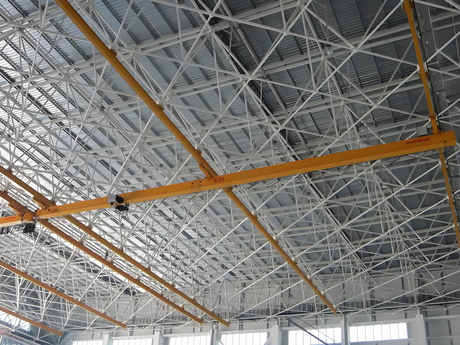
In an overhead crane—whether single-girder or double-girder—the end carriage (also known as an end truck or end beam) is a critical structural component. It supports the entire crane bridge, houses the wheels that run along the runway rails, and ensures smooth, safe, and stable travel during lifting operations.
1. What Is an End Carriage?
An end carriage is a wheeled assembly positioned at both ends of an overhead crane. It enables the crane to move longitudinally along the runway beam. A typical crane has one drive end carriage (with motor) and one non-driven end carriage.
Functions of an End Carriage
• Supports the bridge structure
• Enables crane travel along the runway
• Transfers loads to the building structure
• Houses motors, wheels, axles, and bearings
• Ensures smooth and safe motion
2. Key Components of an End Carriage
Major components include:
• End beam frame
• Wheels and axles
• Bearings
• Gear motor or drive system
• Couplings
• Buffers and rail sweepers
3. Types of End Carriages (According to the Provided Comparison Table)
The supplied image compares two widely used types of end carriages:
• Type A: Open Pinion Type
• Type B: European Hollow Shaft Type
Below is a detailed explanation of each design.
Type A: Open Pinion End Carriage (Traditional Type)
• Work duty: M3
• Wheel material: 45# steel
• Gear motor: Traditional three‑in‑one gear motor
• Typically used in standard single‑girder cranes
• Economical and easy to maintain
Type B: European Hollow Shaft End Carriage (Modern Type)
• Work duty: M5
• Wheel material: 42CrMo alloy steel (low noise, strong, reduced rail wear)
• Gear motor: Parallel-axis helical gear motor (low noise, low energy consumption)
• Compact, smooth-running, energy-efficient design
• Ideal for higher duty cycles and precise handling applications
4. Detailed Comparison Based on Image
1. Structure: Open pinion is bulkier; European type is compact.
2. Duty Rating: M3 (light–medium) vs M5 (medium–heavy).
3. Wheel Material: 45# steel vs 42CrMo alloy.
4. Gear Motor: Traditional vs helical high-efficiency motor.
5. Application Recommendations
Open Pinion Type:
• Standard workshops
• Light manufacturing
• Budget-sensitive projects
European Hollow Shaft Type:
• Automated production lines
• High-frequency lifting
• Low-noise/precision environments
6. Conclusion
Selecting the right end carriage is crucial for crane stability, durability, and performance. The traditional Open Pinion type is suitable for standard-duty applications, while the European Hollow Shaft type offers superior smoothness, lower noise, and higher efficiency for demanding environments.

| | Tel: +86-27-86790925 |
| | Mobile: +86 13720388778 |
| | E-mail: info@vohoboo.com |
| |