

Views: 0 Author: Site Editor Publish Time: 2026-11-13 Origin: Site


Category: Technical Insights & Workstation Lifting Solutions
Target Keywords: Jib Crane Specifications, Pillar Mounted Jib Crane, Slewing Jib Crane, Workstation Lifting, Crane Parameter Checklist, Jib Crane Applications
Reading Time: 5 Minutes
In modern industrial facilities, workstation bottlenecks are frequently caused by material handling delays. When machine operators or assembly workers have to wait for the central overhead bridge crane to move intermediate loads, overall productivity drops significantly.
Jib cranes provide the most cost-effective and flexible solution for dedicated, localized lifting. Whether installed at individual CNC machining stations, assembly cells, or loading bays, a properly engineered jib crane allows operators to lift, transfer, and position loads safely and independently.
However, selecting the right jib crane requires precise technical coordination between the crane manufacturer, civil engineering conditions, and actual operational requirements. This comprehensive guide explains where jib cranes excel, how they work, and the 8 critical parameters every buyer must confirm before placing an order.
Jib cranes are designed for repetitive, high-frequency lifting within a circular or semi-circular operational envelope. Unlike mobile cranes or full-bay overhead cranes, their compact footprint and agile slewing make them indispensable across various industrial sectors:
Loading raw metal billets, heavy castings, or tooling chucks into CNC milling and turning centers requires millimeter-level precision. A dedicated workstation jib crane eliminates operator fatigue and completely removes dependency on the plant’s main overhead crane.
In engine manufacturing, pump assembly, and electrical cabinet fabrication, parts weighing between 250 kg and 5,000 kg must be held, inverted, and precisely mated. Jib cranes equipped with dual-speed electric chain hoists ensure smooth, jerk-free positioning.
Plastic injection molding plants and stamping press workshops frequently swap heavy molds. A pillar-mounted jib crane dedicated to the tool repair area enables quick, safe mold disassembly, inspection, and cleaning.
At the end of a production line, finished equipment must be lifted into crates or onto pallets. Jib cranes with vacuum lifters or motorized trolleys speed up packing cycles while preventing worker strain.
Specialized heavy-duty jib cranes with IP55/IP65 weatherproofing, rain covers, and anti-corrosive epoxy paint serve outdoor loading bays, boatyards, and rail-side staging zones.
A standard freestanding pillar-mounted jib crane consists of five primary mechanical modules:
Vertical Column (Pillar / Mast): Engineered from heavy-wall structural steel pipe, designed to absorb high bending moments and dynamic overturning forces.
Rotating Jib Arm (Boom / Cantilever Beam): Fabricated from I-beams or enclosed track profiles (H-beam / KBK profile) where the trolley travels horizontally.
Slewing Mechanism & Pivot Bearing: Heavy-duty bearing assembly enabling smooth rotation, operated either manually via slewing handle or powered by an electric motor reducer.
Lifting Hoist & Trolley: An electric chain hoist or wire rope hoist providing vertical lifting, combined with a manual push or motorized trolley for horizontal travel.
Anchor Base Plate & Foundation: A reinforced base ring secured by high-tensile anchor bolts directly to the concrete floor or a dedicated civil engineering foundation.
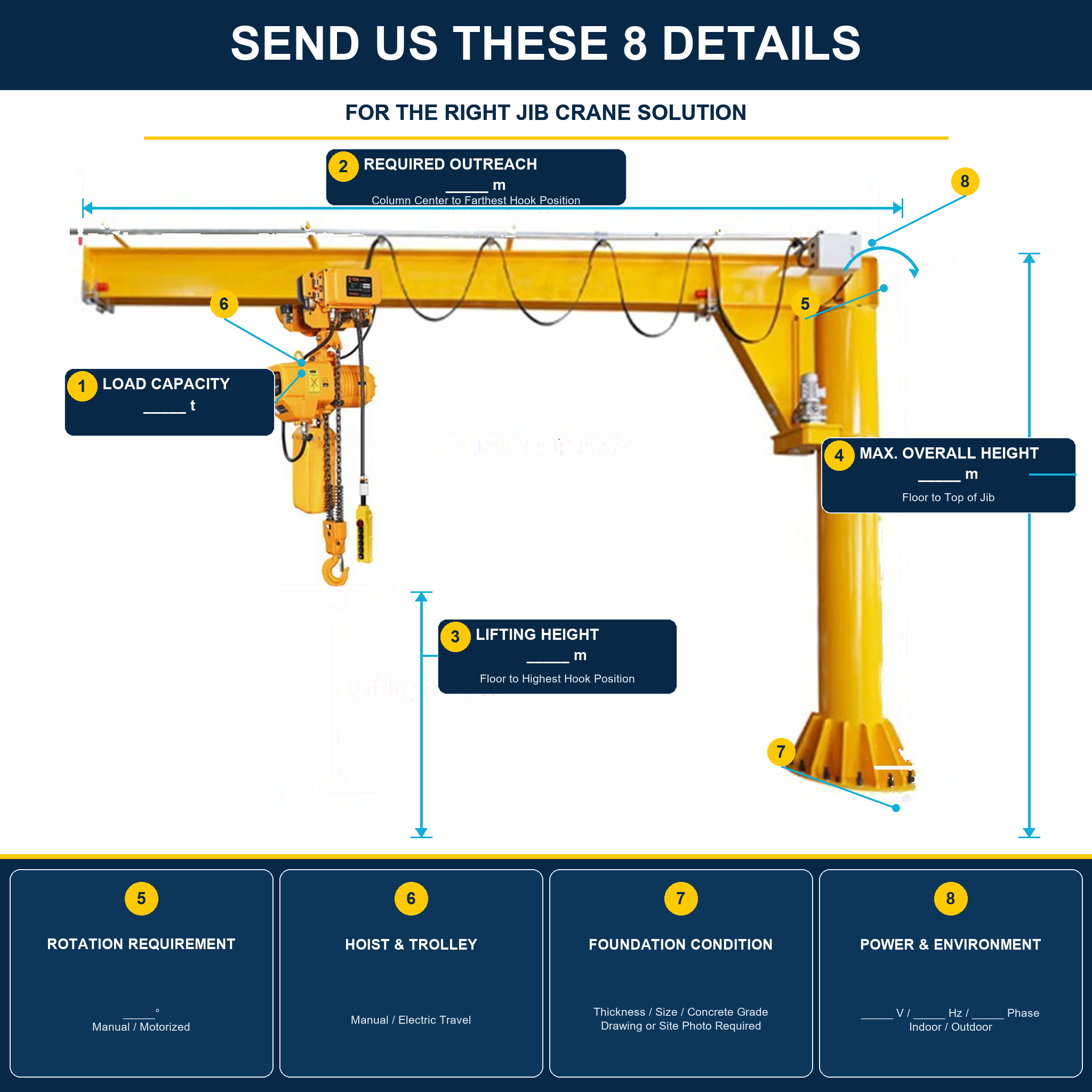
To avoid costly misalignments, structural over-engineering, or safety hazards, every customized jib crane inquiry should specify the following 8 fundamental parameters:
[Insert Image Here: 8 Parameters to Confirm for Jib Crane Solution]
(Recommended Placement: Insert your confirmed 8-parameter technical infographic showing the pillar, arm, hoist, height dimensions, and base plate.)
A common buyer mistake is asking for a "5-meter arm" when they need a "5-meter working reach." Because the trolley has buffer stops at both ends and the column has an offset radius, a 5-meter structural arm typically yields only 4.2 to 4.5 meters of usable hook travel. Always specify Effective Outreach (Column Center to Farthest Hook Position).
Unlike gantry cranes which distribute loads through four wheels, a freestanding jib crane concentrates extreme overturning moments at its single base. Standard factory slabs (150–200 mm) can generally support smaller capacities (up to 1t or 2t with short outreach). Heavy loads (3t–5t with long reach) require either:
A dedicated reinforced concrete foundation pit (typically 1.2m–1.8m deep).
A heavy-duty enlarged steel base plate or through-bolt clamping structure.
If your plant already operates a top-running bridge crane above the workstations, ensure the top of the jib crane clears the lowest point of the bridge crane's end carriage and festoon cables with at least 200 mm of safety buffer.
When preparing an RFQ (Request for Quotation), copy and fill in this standard checklist to receive an accurate CAD drawing and quotation within 24 hours:

| | Tel: +86-27-86790925 |
| | Mobile: +86 13720388778 |
| | E-mail: info@vohoboo.com |
| |


