Views: 5 Author: Site Editor Publish Time: 2025-10-24 Origin: Site


In the world of material handling and industrial lifting, the terms “hoist” and “crane” are often used interchangeably. However, they refer to different equipment with distinct functions, capabilities, and applications. Understanding the differences between these two is essential for selecting the right lifting solution for your workshop, warehouse, or industrial facility.
This guide explains the main distinctions, features, and use cases for hoists and cranes, helping you make informed decisions for your material handling needs.
1. What Is a Hoist?
A hoist is a mechanical device used to lift or lower heavy loads vertically. Hoists are often mounted on fixed points, such as beams, rails, or cranes, and can be operated manually or electrically.
Key Features of Hoists:
- Provides vertical lifting for various load capacities.
- Available in electric chain hoists, wire rope hoists, or manual types.
- Compact and space-efficient, suitable for workshops and assembly lines.
- Can be combined with cranes, monorails, or jib systems for horizontal movement.
Applications of Hoists:
- Lifting engines, equipment, or machinery components.
- Material handling in factories, warehouses, and assembly lines.
- Workstations and maintenance bays with limited space.
2. What Is a Crane?
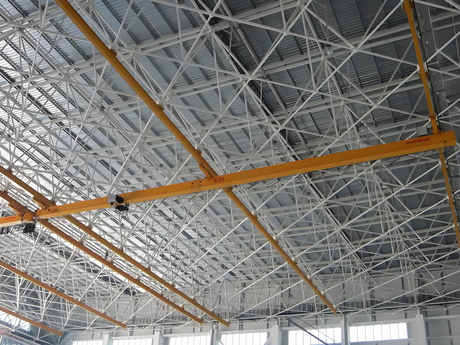
A crane is a larger lifting system designed to move loads both vertically and horizontally over a specific working area. Cranes often incorporate hoists to perform the actual lifting.
Key Features of Cranes:
- Can lift heavier loads and cover larger workspaces.
- Equipped with horizontal movement, such as traveling bridges, gantry rails, or jib arms.
- Available in multiple types: overhead bridge cranes, gantry cranes, jib cranes, and tower cranes.
- Operated via manual control, pendant control, or fully automated systems.
Applications of Cranes:
- Workshops, production lines, and warehouses.
- Heavy industries like steel plants, shipyards, and construction.
- Long-span or high-capacity lifting tasks where hoists alone are insufficient.
3. Main Differences Between Hoists and Cranes
- Function: Hoist lifts vertically; crane lifts vertically and horizontally.
- Movement: Hoist is fixed or limited; crane covers the full workspace.
- Capacity: Hoist handles light to medium loads; crane handles medium to heavy loads.
- Size: Hoist is compact; crane is larger and requires space.
- Flexibility: Hoist is easy to install; crane may be fixed or semi-fixed.
- Applications: Hoist suits small workstations; crane suits factories and large industrial sites.
4. How Hoists and Cranes Complement Each Other
Many industrial lifting solutions combine hoists and cranes for maximum efficiency:
- Overhead Bridge Cranes: The hoist is mounted on the bridge to lift loads and travel along the span.
- Jib Cranes: Hoists provide the vertical lift, while the jib arm allows limited horizontal movement.
- Gantry Cranes: Hoists handle heavy lifting, and the gantry structure enables transport across outdoor or indoor areas.
By integrating hoists with cranes, facilities can achieve precise, safe, and efficient material handling across complex workflows.
5. Factors to Consider When Choosing Between Hoists and Cranes
- Load Capacity: Heavy loads may require cranes with integrated hoists.
- Workspace Layout: Limited space may favor standalone hoists or jib cranes.
- Movement Requirements: If horizontal movement is necessary, a crane is essential.
- Frequency of Use: High-frequency operations benefit from electric hoists and automated cranes.
- Budget and Maintenance: Hoists are generally more affordable; cranes involve higher upfront costs and maintenance planning.
6. Conclusion
While hoists and cranes share the goal of lifting and moving loads, they serve different purposes:
- Hoists are ideal for vertical lifting in compact areas and can be combined with cranes or other structures.
- Cranes provide full vertical and horizontal mobility, enabling large-scale material handling and supporting heavier loads.
Choosing the right equipment ensures productivity, safety, and efficiency in your industrial environment.

| | Tel: +86-27-86790925 |
| | Mobile: +86 13720388778 |
| | E-mail: info@vohoboo.com |
| |